


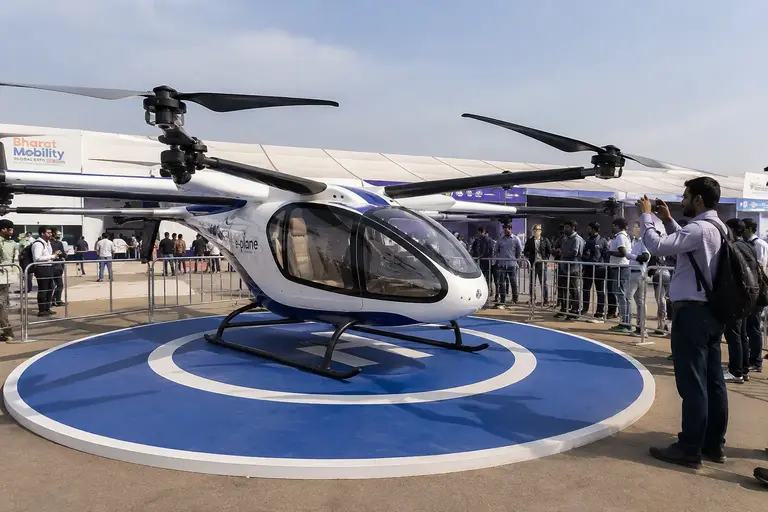
India has officially entered the age of electric flying taxis. But before you imagine hopping into a sleek air-taxi to skip your morning traffic jam, here’s the twist: the country’s first electric vertical take-off and landing (eVTOL) aircraft will spend its early years saving lives in hospitals, not shortening commutes to the office.
The aircraft is called PT-01, and it was unveiled by The ePlane Company, a Chennai-based deep-tech startup incubated at IIT Madras.
What Is the PT-01 Flying Taxi?
PT-01 is India’s first full-scale eVTOL prototype — essentially an aircraft that takes off and lands straight up like a helicopter but flies forward like a fixed-wing plane. It was unveiled at ePlane’s newly opened 60,000-square-foot production facility on the IIT Madras Discovery Campus in Chennai.
The prototype is built on the company’s e200X platform, developed by Professor Satya Chakravarthy, an IIT Madras aerospace engineer who has also co-founded space-tech startups Agnikul Cosmos and GalaxEye, as well as TuTr Hyperloop.
Key Specifications
- Weight: Roughly 2.2 tonnes
- Wingspan: 8 metres — deliberately compact so it can land in tight urban spaces
- Range: Around 110 km on a single charge
- Payload: Pilot plus up to 200 kg — enough for a patient, a paramedic, and medical equipment
- Footprint: Small enough to operate from a space roughly half the size of a basketball court
- Safety: Multiple independent electric propellers give it built-in redundancy if one motor fails
Unlike conventional aircraft, an eVTOL doesn’t need a runway. Multiple battery-powered propellers let it lift off vertically, which means it can use hospital helipads and rooftop landing zones with little to no modification.
Why Air Ambulances Come Before Passenger Flights
Instead of launching straight into a passenger air-taxi service, ePlane is starting with emergency medical transport. It’s a practical choice: hospitals already have dedicated landing spaces, and the value of faster transport during a medical emergency is immediate and easy to prove — unlike convincing daily commuters to trust a new form of transport.

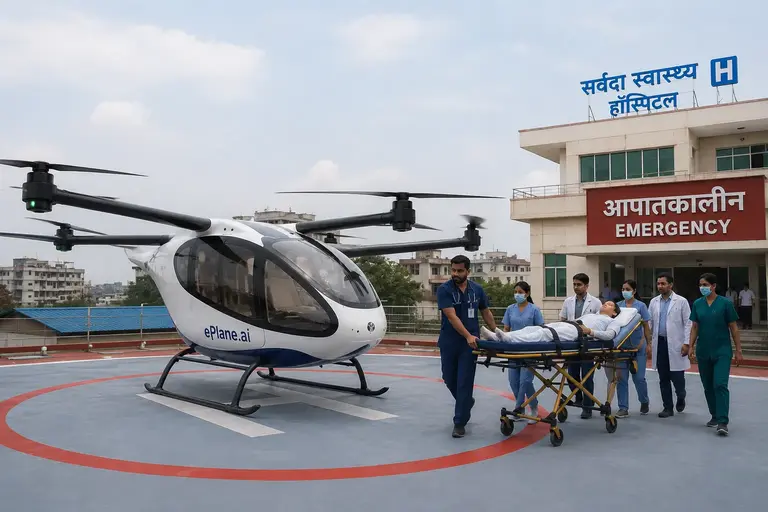
The strategy already has institutional backing. In February 2025, the International Critical Air Transfer Team signed a deal with ePlane to procure hundreds of eVTOL air ambulances, signalling real early demand for the technology.
Once the air-ambulance model is proven, ePlane plans to expand into airport transfers and eventually full urban passenger air-taxi services.
What’s the Timeline?
- Ground testing: Expected to begin next year
- Flight trials: Unmanned test flights first, followed by piloted trials as part of certification
- Commercial operations: Targeted for around 2028, starting with medical services
The PT-01 is the result of nearly five years of research, computational modelling, and progressively larger flying demonstrators — this isn’t a first attempt, but the latest stage of a long development pipeline.
India Joins a Global Race
With this prototype, India enters a global eVTOL race already underway in the US, Europe, and the Middle East, where companies are racing to build electric aircraft that can beat traffic and shrink city commute times.

But a working prototype is only the first milestone. The bigger challenge ahead is turning PT-01 into a certified, commercially viable aircraft — a process that will depend on successful test flights and regulatory clearances from Indian and international aviation authorities.
The Bottom Line
India’s first flying taxi isn’t going to whisk office-goers over traffic just yet. Its real debut will likely be far more urgent: ferrying patients to hospitals faster than an ambulance ever could. If that mission succeeds, the leap from air ambulance to everyday air taxi may not be far behind.
Have thoughts on India’s eVTOL future? Share this article and let us know what you think in the comments below.