


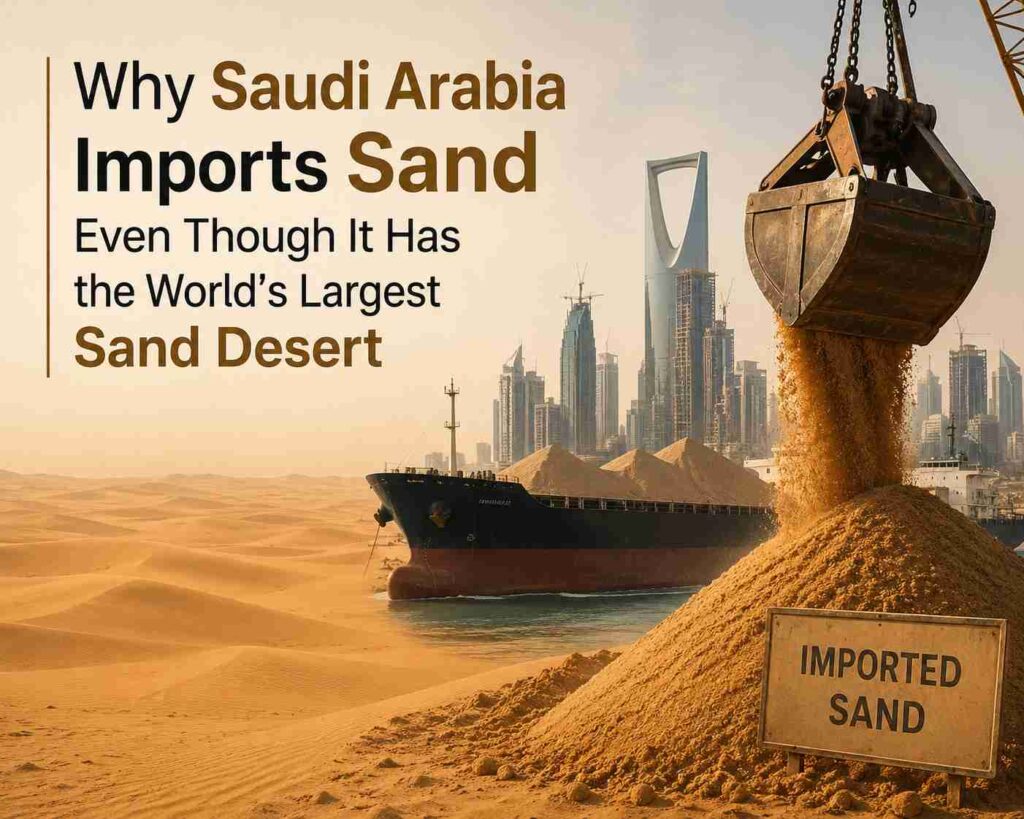
Meta Title: Why Does Saudi Arabia Import Sand? The Surprising Science Explained Meta Description: Saudi Arabia sits on the massive Rub’ al Khali desert, yet it still imports sand from Australia and Scotland. Here’s the surprising engineering reason why. Focus Keywords: why does Saudi Arabia import sand, desert sand vs construction sand, sand shortage, Rub al Khali sand
A Desert Nation That Still Has to Buy Sand
It sounds like a joke: a country covered by one of the largest sand seas on Earth pays other nations to ship sand to its ports. But it’s true. Saudi Arabia, home to the Empty Quarter (Rub’ al Khali) — a desert roughly the size of France — regularly brings in shiploads of sand from places like Australia and Scotland. To understand why, you don’t need geography. You need physics.
Not All Sand Is Created Equal
Sand is graded by geologists according to how it formed, and that origin story matters far more than most people realize. Two grains of sand can look nearly identical to the naked eye and still behave completely differently once you try to build with them.

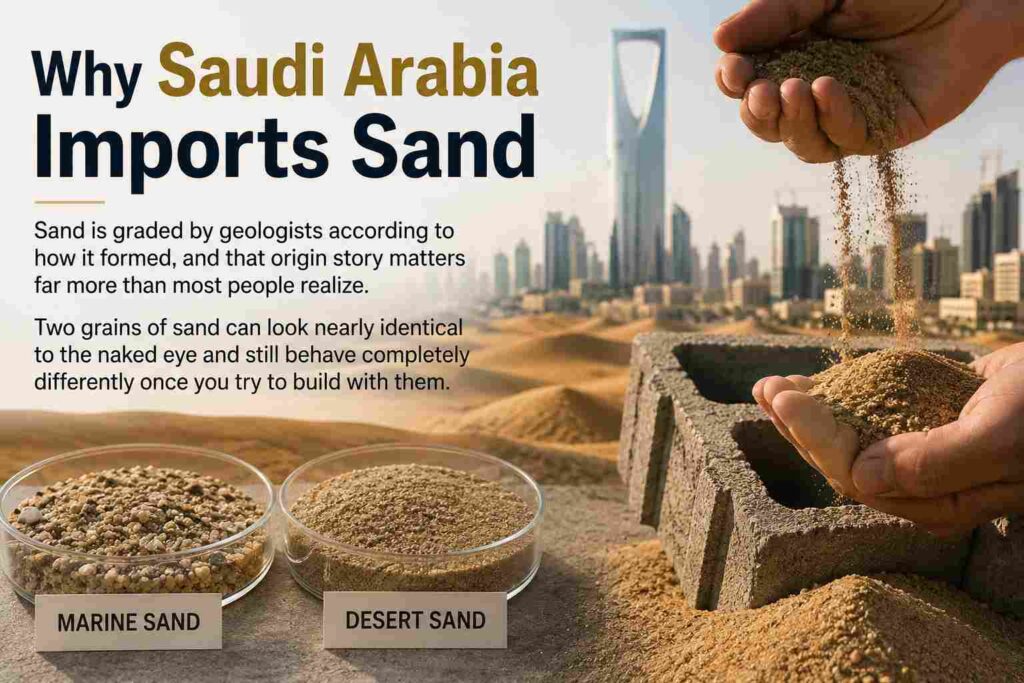
The sand that piles into the towering dunes of the Empty Quarter has spent thousands of years being tumbled and polished by wind. Over time, this constant bouncing and grinding wears each grain into a smooth, almost spherical shape. It’s beautiful to look at and pleasant to walk on — but it’s structurally useless for construction.
Why Smooth, Wind-Polished Grains Fail in Concrete
Concrete strength depends on friction and interlock, not just on the raw material being “sand.” When engineers mix cement, water, and aggregate, they’re relying on the individual grains to lock against one another, creating a stable matrix that can bear weight and resist cracking.
Rounded desert grains slide past each other instead of gripping. Picture trying to build a stable pile out of polished marbles versus a pile of jagged gravel — the marbles simply won’t hold their shape or bond well with a binding paste. The result, when desert sand is used in concrete, is a weaker mix prone to cracking, poor load-bearing capacity, and long-term structural risk.
River sand and sand mined from quarries, by contrast, form under completely different conditions. Water transport and mechanical crushing leave grains with rough, angular edges. Those edges catch and interlock, giving concrete its strength. This is the exact type of sand construction crews need — and it’s what Saudi Arabia has to import from coastal and riverine sources abroad, including parts of Australia and Scotland where suitable sand deposits are dredged or quarried.
The Bigger Picture: A Global Construction Sand Shortage
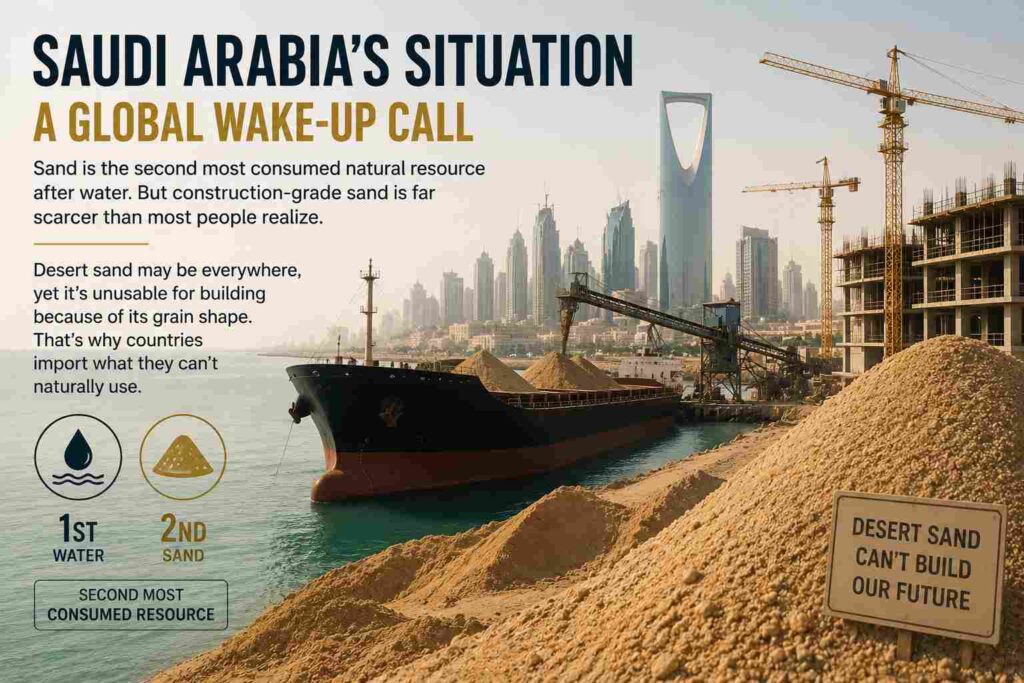
Saudi Arabia’s situation is a dramatic example of a much larger global problem. Sand is technically the second most consumed natural resource on the planet after water, and construction-grade sand is far scarcer than people assume. Desert sand, despite covering roughly a fifth of the world’s land in arid zones, is essentially off-limits for building because of this same grain-shape issue.
That leaves the construction industry dependent on:
- River sand, which is increasingly regulated or banned in many countries due to riverbed erosion and ecosystem damage
- Marine and dredged sand, extracted from the seafloor
- Crushed quarry rock, processed into angular manufactured sand
As global infrastructure and urbanization accelerate — especially in fast-growing Gulf cities — demand for angular, “usable” sand has outpaced easily accessible supply, driving up both cost and the environmental footprint of extraction.
Could Engineered or Recycled Sand Solve This?
Researchers and materials scientists are actively working on alternatives that could someday reduce this reliance on imported sand, including:
- Crushing desert sand mechanically to artificially roughen its surface, though this is energy-intensive and expensive at scale
- Manufactured sand (M-sand) produced by crushing hard rock into angular particles as a substitute for natural river sand
- Recycled construction and demolition waste, reprocessed into usable aggregate
- Alternative binders and 3D-printed construction techniques that require less traditional sand-based concrete altogether
None of these has fully closed the gap yet, which is why sand imports remain a routine, if strange-sounding, part of Gulf construction logistics.
FAQ
Does Saudi Arabia have any usable sand at all? Yes — but suitable deposits are limited and don’t come close to meeting the volume construction demands, so imports fill the gap.
Is this only a Saudi Arabia problem? No. Other desert nations, including parts of the UAE and North Africa, face the same paradox for the same structural reason.
Why not just use desert sand for less critical projects? It can be used for fill, landscaping, or non-structural purposes — just not for concrete that needs to bear real load.
The Takeaway
Saudi Arabia’s sand imports aren’t a logistics oversight — they’re a direct consequence of how differently wind and water shape the same raw material. The Empty Quarter’s dunes may be endless, but their smooth, wind-rounded grains simply can’t do the structural job that rough, angular sand does. Until new materials or processing methods close that gap affordably, the world’s biggest sand deserts will keep depending on ships full of someone else’s sand.
This article was researched and written for [Your Site Name]. Sources of underlying facts and figures should be independently verified and linked where appropriate before publishing.