


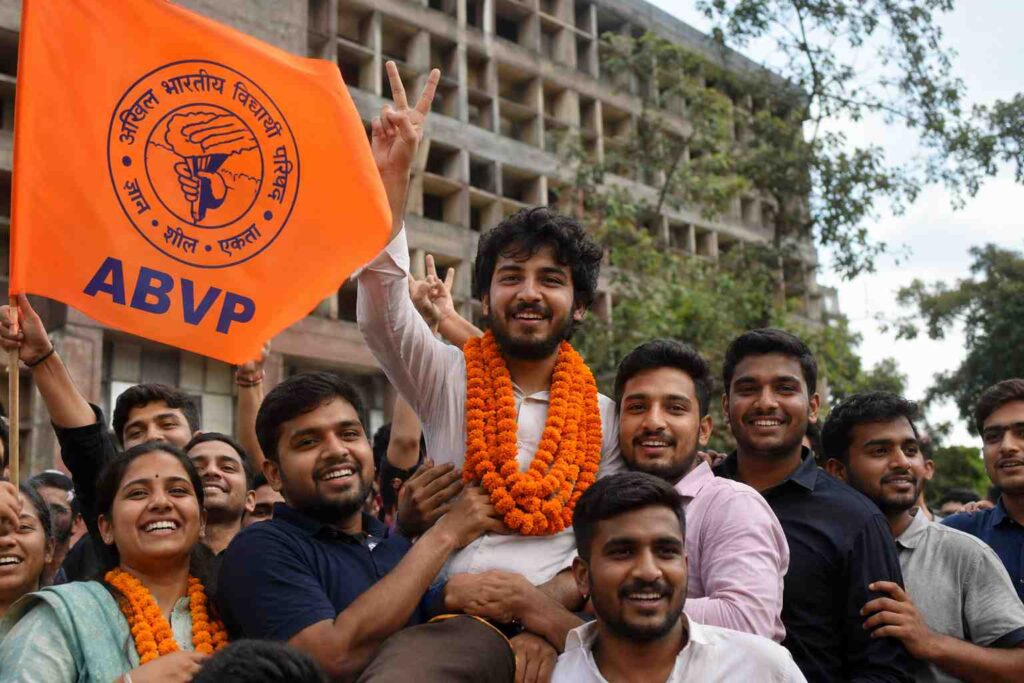
Student politics rarely makes national headlines, but the outcome of this year’s Panjab University Campus Students’ Council (PUCSC) election is being read as something bigger than a campus contest. With the Punjab Assembly election barely six months away, the result has turned into an early referendum on which political camp holds sway over the state’s young voters.
What Happened at Panjab University
Polling for the PUCSC president’s post and other top council positions was held on August 31, 2026, and it turned into a closely fought four-cornered race. When the counting finished, Akhil Bharatiya Vidyarthi Parishad (ABVP) candidate Ankit Bidhan, a PhD research scholar from Jind, Haryana, emerged victorious, defeating AAP-backed Association of Students for Alternative Politics (ASAP) candidate Adil Brar by a margin of 512 votes.
According to the officially declared numbers, Bidhan polled 3,149 votes against Brar’s 2,637. Congress’s student wing NSUI, represented by Gurman Singh Sidhu, finished third with 2,263 votes, while SATH candidate Darshpreet Singh trailed with 1,387 votes.
This is the second consecutive year ABVP has captured the top post at Panjab University — a feat the organisation had not managed in nearly five decades before last year’s breakthrough win. Back-to-back victories now put ABVP in a stronger position on campus than at any point in recent memory.
The Alliance Behind the Win
A key factor behind this year’s result was a fresh political tie-up. The Student Organisation of India (SOI) — the student wing of the Shiromani Akali Dal (SAD) — chose not to field its own candidate for president and instead threw its weight behind Bidhan. That consolidation of votes is widely seen as decisive in helping ABVP cross the winning line.

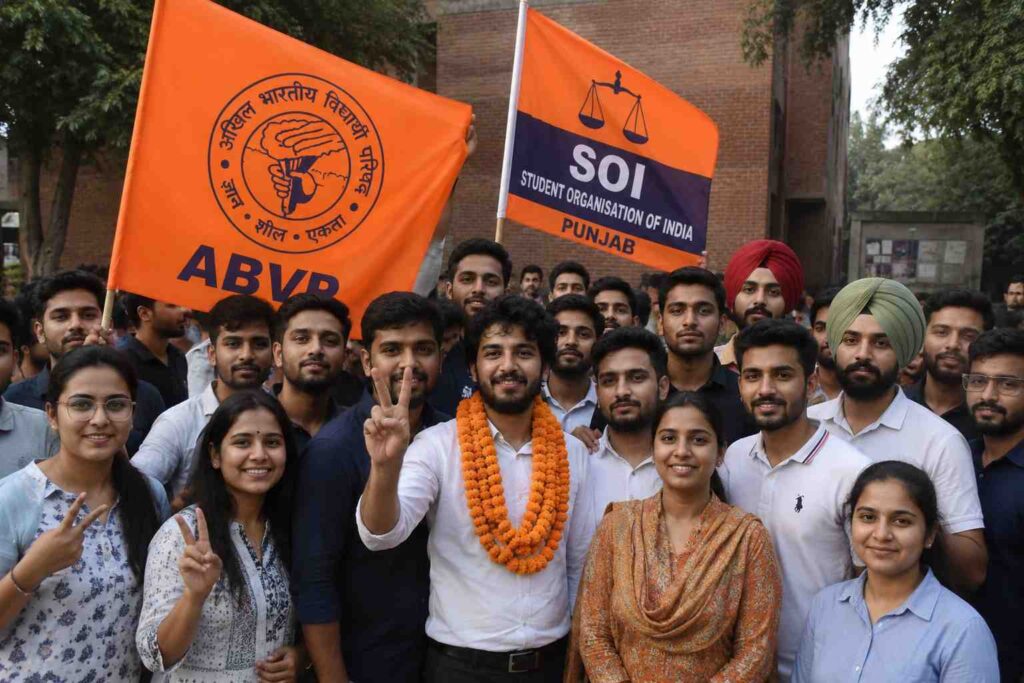
The timing is notable. Just days before polling, senior SAD leader Bikram Singh Majithia had publicly suggested that people in Punjab wanted the BJP and Akali Dal — once long-standing allies — to reunite, citing the state’s sensitive border location and the need for social harmony. The SOI-ABVP understanding on campus is being viewed by many political observers as an early trial run for a similar arrangement at the state level ahead of 2027.
Not everyone is reading it that way, though. Congress leader Amarinder Singh Raja Warring was quick to criticise the Akali Dal’s student wing for backing ABVP, calling out what he described as inconsistency in the SAD’s political positioning.
Other Council Results
The presidential race wasn’t the only contest decided on campus. Here’s how the other top posts panned out:
- Vice-President: Armaan Singh Bhinder won with 3,322 votes, defeating Akanksha Thakur
- Secretary: Dhyan Singh secured victory with 4,045 votes, ahead of Aryan Saharan’s 3,678
- Joint Secretary: Vishal Bamal won with 3,506 votes against Dev Raj Singh Nain’s 2,338
Together, these newly elected representatives will lead the student council through the 2026–27 academic session.
Why a Campus Election Is Being Watched by State Politicians
Student union results at Panjab University have historically served as an informal mood indicator among Punjab’s youth, and this year both the BJP and its rivals were watching closely. BJP’s Punjab in-charge and MP Satish Poonia reacted to the result by framing it as proof of a larger appetite among young voters for what he called a “double-engine” government — his term for coordinated BJP-led governance. He also confirmed the party intends to contest all 117 Assembly seats in the 2027 Punjab election and said internal strategy discussions, including a visit to Jalandhar, would follow soon.
Security was notably tight through polling day, with checks intensified at all three entry gates of the university amid concerns over the movement of outsiders during the highly charged contest.
It’s worth noting that Bidhan’s candidacy wasn’t free of controversy — his nomination had faced objections over an FIR linked to an alleged clash between rival ABVP factions in 2024. ABVP maintained he remained eligible since the case had not resulted in a chargesheet or conviction, and the Election Commission’s guidelines allowed his candidature to stand.
The Bigger Picture: What It Means for 2027
With Punjab’s Assembly election approaching, every data point about shifting political loyalties among first-time and young voters is being scrutinised. ABVP’s second straight win — this time bolstered by an alliance with the Akali Dal’s student wing — suggests two things worth watching:
- A possible BJP-SAD realignment at the state level could be taking early shape through campus-level cooperation.
- Young voter sentiment in Punjab may not be as uniformly anti-incumbent-party as some recent trends suggested, though a single university election is far from a definitive statewide signal.
Whether this campus result actually translates into votes across Punjab’s 117 constituencies in 2027 remains to be seen — but for now, it’s given the BJP and its allies a symbolic win to build momentum on, and it’s given rival parties a fresh talking point about political alliances of convenience.
FAQs
Q1. Who won the Panjab University student council president election in 2026? ABVP’s Ankit Bidhan won the PUCSC president post, defeating AAP-backed ASAP candidate Adil Brar by 512 votes.
Q2. How many votes did Ankit Bidhan get? Bidhan secured 3,149 votes against Adil Brar’s 2,637 votes in the four-way presidential contest.
Q3. Is this ABVP’s first win at Panjab University? No, it’s ABVP’s second consecutive win. The organisation first won the presidency last year after nearly 50 years without a win at the top post.
Q4. Why is this student election linked to the 2027 Punjab Assembly polls? Because the win came with support from the Akali Dal’s student wing (SOI), it’s being seen as a possible preview of a BJP-SAD alliance ahead of the 2027 state election.
Q5. Who else won posts in the PUCSC election? Armaan Singh Bhinder (Vice-President), Dhyan Singh (Secretary), and Vishal Bamal (Joint Secretary) were the other winners.
This article is based on independent reporting and verified election data as of September 1, 2026. Figures and statements are subject to official confirmation by Panjab University authorities.